Thursday, November 11, 2010

S'darn cute!

I just stumbled upon this blog from a friend on Facebook:
This Animal Is Awesome

(Warning: For some reason, page 1 of the blog has nudity. So the link goes to page 2. Now you're just curious, I know. I just didn't want to be inappropriate.)

Here are some highlights for your viewing pleasure:


P.S. Check out their ARCHIVE!

Monday, November 1, 2010

Today in History, 1512...

The ceiling of the Sistine Chapel in Rome, one of Italian artist Michelangelo's finest works, is exhibited to the public for the first time.


Michelangelo Buonarroti, the greatest of the Italian Renaissance artists, was born in the small village of Caprese in 1475. The son of a government administrator, he grew up in Florence, a center of the early Renaissance movement, and became an artist's apprentice at age 13. Demonstrating obvious talent, he was taken under the wing of Lorenzo de' Medici, the ruler of the Florentine republic and a great patron of the arts. After demonstrating his mastery of sculpture in such works as the Pieta (1498) and David (1504), he was called to Rome in 1508 to paint the ceiling of the Sistine Chapel—the chief consecrated space in the Vatican.

Michelangelo's epic ceiling frescoes, which took several years to complete, are among his most memorable works. Central in a complex system of decoration featuring numerous figures are nine panels devoted to biblical world history. The most famous of these is The Creation of Adam, a painting in which the arms of God and Adam are stretching toward each other. In 1512, Michelangelo completed the work.

After 15 years as an architect in Florence, Michelangelo returned to Rome in 1534, where he would work and live for the rest of his life. That year saw his painting of the The Last Judgment on the wall above the altar in the Sistine Chapel for Pope Paul III. The massive painting depicts Christ's damnation of sinners and blessing of the virtuous and is regarded as a masterpiece of early Mannerism.

Michelangelo worked until his death in 1564 at the age of 88. In addition to his major artistic works, he produced numerous other sculptures, frescoes, architectural designs, and drawings, many of which are unfinished and some of which are lost. In his lifetime, he was celebrated as Europe's greatest living artist, and today he is held up as one of the greatest artists of all time, as exalted in the visual arts as William Shakespeare is in literature or Ludwig van Beethoven is in music.

http://www.history.com/this-day-in-history


For an extra awesome look at the Sistine Chapel, check out this blog post by Ms. Julia.
Monday, October 18, 2010

Sloth Fact #2, by Meghan

There are two main species of sloths, categorized by whether they have two or three claws. Two-toed sloths are a little bigger, but Three-toed sloths have two extra vertebrae that allow them to turn their heads almost all the way around! Awesome.


Thursday, September 30, 2010

Why is November 19th so far away?!


I do believe I must own this poster.


Watch the trailer here:
http://www.imdb.com/video/imdb/vi2799962393/

(I am not embarrassed to admit that I cried a little the first time I saw this.)


How these days grow long...

I think that a defining characteristic of many nerds is their tendency toward fixation. Simply put, we get to be a little bit obsessed about the nerdy things we love. Like Julia and her wolves. Man, that girl... obsessed. Haha, joking of course, as I am the queen of nerdy fixations. Take my current music obsession, for example.

Oh, Brandi Carlile, I have an absurd amount of love for you. Watch these videos, and you may fall in love with her too.


04/19/09@ The State Room (First time I saw her live- SO AWESOME- though this video is not mine.)


This is one of the most sad, beautiful songs I have ever heard. Love it.

Wednesday, September 29, 2010

Wolves, Part III


The title of this post should actually be "Nature Knows Better." And because of people that disagree, wolves are being endangered, but only here in the West. This articled entitled "The Big Bad Wolf Makes Good: The Yellowstone Success Story and Those Who Want to Kill It" by Chip Ward details it eloquently.

Read the article, but this gist is this. Wolves are, in fact, a key part of the ecosystem in Yellowstone and the surrounding areas. (Imagine that!) Without them, there is literally less water. Fewer wolves mean more elk. More elk mean over-grazed willows. Fewer willows mean fewer beavers. Fewer beavers mean fewer dams, fewer dams mean fewer wetlands, fewer wetlands mean fewer fish, birds, bugs, and amphibians, as well as less water distribution. You push that first domino, and the whole bunch topples.

Wolf reintroduction wasn’t a scheme designed to undermine vacationing elk hunters or harass ranchers who graze their cattle on public lands. It wasn’t done to please some cabal of elitist, urban environmentalists eager to show rural rednecks who’s the boss, though out here in the West that interpretation’s held sway at many public meetings called to discuss wolf reintroduction.

Let’s be clear then: the decision to put wolves back in Yellowstone was a bold experiment backed by the best conservation science available to restore a cherished American ecosystem that was coming apart at the seams.


When wolves were reintroduced into Yellowstone in the mid-nineties, the ecosystem bounced back. They were taken off the endangered species list, and hunters were free to shoot to kill. In August of this year, they were put back on the endangered species list by the federal government. There are, of course, objections from local farmers and hunters, and the article addresses them well. But ultimately, nature knows better:
Think of wolf reintroduction, then, as a kind of hinge-point between the two paradigms. After centuries of not leaving the natural world’s order to chance, micro-managing wherever we could, we are now encouraged to take a chance on Nature, to trust the self-organizing powers of life to heal ecosystems we have wounded....We now understand far better the many ways in which nature’s living communities are astonishingly connected and reciprocal. If we could only find the courage to trust their self-organizing powers to heal the wounds we have inflicted, we might become as resilient as those Yellowstone wolves.

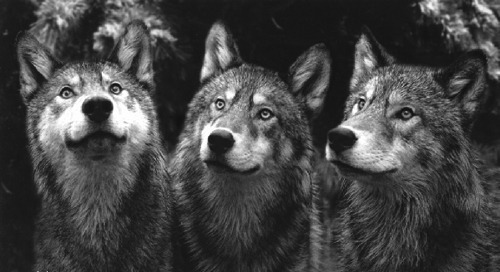
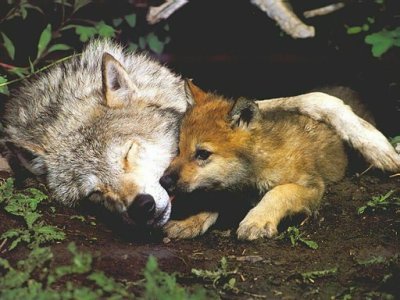
I just searched google images for "wolf hunting." Don't worry, I covered my eyes before any actual tears fell, but needless to say, I'll never do that again. I did find this gem, though:
Oh, buddies.